> ## Documentation Index
> Fetch the complete documentation index at: https://docs.opentype.dev/llms.txt
> Use this file to discover all available pages before exploring further.
# API key security
> How OpenType stores API keys, why the secret is shown once, how to revoke and rotate keys, and what to do when a secret leaks.
This page is for whoever creates, stores and retires OpenType API keys. It explains what a key is made of, what OpenType keeps and what it never keeps, how revocation and rotation behave, and the exact steps to take when a secret leaks.
## Anatomy of a key
A key has an id, a secret and a display prefix. Only the secret is a credential.
| Part | Format | Example | Where it goes |
| --------------- | ------------------------------------------------------ | -------------------------------------- | ------------------------------------------------------ |
| Secret | `otsk_` + 64 lowercase hex, 69 characters | `otsk_...` | Only the `Authorization: Bearer` header |
| Key id | `key_` + 32 hex | `key_d12af855ae0f45b9925223d65562fd0e` | URLs such as `DELETE /v1/keys/{key_id}`, logs, tickets |
| `secret_prefix` | The first 13 characters of the secret: `otsk_` + 8 hex | `otsk_fde66231` | Key lists, so you can tell keys apart |
The `otsk_` prefix makes a leaked secret easy to find with a secret scanner. The 64 hex characters that follow are randomly generated.
## What OpenType stores
| Stored | Not stored |
| ------------------------------------------------------------------------------------------------------------------- | --------------------------------------------------- |
| The SHA-256 digest of the full secret, used to look the key up | The secret itself, in any form that can be reversed |
| `secret_prefix`, in plaintext, so keys can be listed | |
| The key's `id`, `name`, `principal`, `scopes`, `state`, `created_by`, `created_at`, `last_used_at` and `revoked_at` | |
* Verification hashes the secret you send and compares digests in constant time.
* The server never writes the secret to its logs.
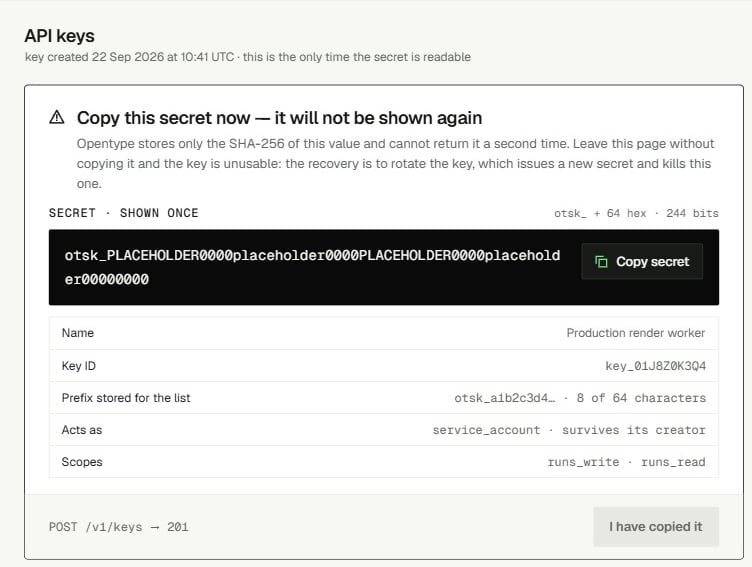
* Because only the digest is kept, **OpenType cannot show you a secret again**, and neither can anyone who reads the stored key data.
## The secret is shown once
The plaintext secret appears in exactly two responses:
| Call | Status | Contains `secret` |
| ------------------------------------------------------------------- | ------ | ----------------- |
| `POST /v1/keys` (create) | 201 | yes |
| `POST /v1/keys/{key_id}/rotate` | 200 | yes, the new one |
| `GET /v1/keys`, `GET /v1/keys/{key_id}`, `DELETE /v1/keys/{key_id}` | 200 | never |
Put the secret in a secret manager, or your platform's encrypted environment variables, before you do anything else with the response. If you lose it, you cannot recover it: [rotate the key](#rotate-a-key) or create a new one.
### Create a key
This creates a key that can send runs and read them back. The calling credential needs `keys_write`. See [Scopes and roles](/security/scopes-and-roles) for choosing scopes.
```bash curl theme={"system"}
curl -sS https://api.opentype.dev/v1/keys \
-H "Authorization: Bearer $OPENTYPE_API_KEY" \
-H "Content-Type: application/json" \
-d '{"name": "ticket-router-prod", "scopes": ["runs_write", "runs_read"]}'
```
```ts TypeScript theme={"system"}
const res = await fetch("https://api.opentype.dev/v1/keys", {
method: "POST",
headers: {
Authorization: `Bearer ${process.env.OPENTYPE_API_KEY}`,
"Content-Type": "application/json",
},
body: JSON.stringify({ name: "ticket-router-prod", scopes: ["runs_write", "runs_read"] }),
});
if (res.status !== 201) throw new Error(`key create failed: ${res.status}`);
const key = await res.json();
// key.secret is in this response only. Write it to your secret manager now,
// and never log it. Log key.id instead.
console.log(`created ${key.id} (${key.secret_prefix})`);
```
```python Python theme={"system"}
import os
import requests
res = requests.post(
"https://api.opentype.dev/v1/keys",
headers={"Authorization": f"Bearer {os.environ['OPENTYPE_API_KEY']}"},
json={"name": "ticket-router-prod", "scopes": ["runs_write", "runs_read"]},
timeout=30,
)
res.raise_for_status()
key = res.json()
# key["secret"] is in this response only. Write it to your secret manager now,
# and never log it. Log key["id"] instead.
print(f"created {key['id']} ({key['secret_prefix']})")
```
```json theme={"system"}
{
"id": "key_d12af855ae0f45b9925223d65562fd0e",
"name": "ticket-router-prod",
"principal": {"type": "user", "id": "user_example"},
"scopes": ["runs_read", "runs_write"],
"state": "active",
"secret_prefix": "otsk_fde66231",
"created_by": "user_example",
"created_at": "2026-09-24T10:12:03Z",
"last_used_at": null,
"revoked_at": null,
"secret": "otsk_..."
}
```
The console does the same in two steps and shows the secret once on the second:
 ## Key object fields
| Field | Type | Notes |
| --------------- | ---------------- | ------------------------------------------------------------------------- |
| `id` | string | `key_` + 32 hex. Safe to log. |
| `name` | string | A label. Names do not have to be unique. |
| `principal` | object | `{"type": "user" \| "service_account", "id": "..."}`: who the key acts as |
| `scopes` | array of strings | Sorted, without duplicates. Fixed when the key is created. |
| `state` | string | `active` or `revoked` |
| `secret_prefix` | string | `otsk_` + 8 hex |
| `created_by` | string | The subject that created the key |
| `created_at` | string | UTC, `YYYY-MM-DDTHH:MM:SSZ` |
| `last_used_at` | string or null | `null` until the key is first used |
| `revoked_at` | string or null | Set when the key is revoked |
| `secret` | string | Create and rotate responses only |
There is no `expires_at`: keys do not expire.
## Lifecycle rules
| Rule | What it means for you |
| ---------------------------------- | ------------------------------------------------------------------------------------------------------------------------------------- |
| **Keys never expire** | A key works until you revoke it. Put revocation in your offboarding and decommissioning steps, and review old keys regularly. |
| **`last_used_at` is approximate** | It is updated in the background, at most once every 60 seconds per key. Use it to find unused keys, not to audit individual requests. |
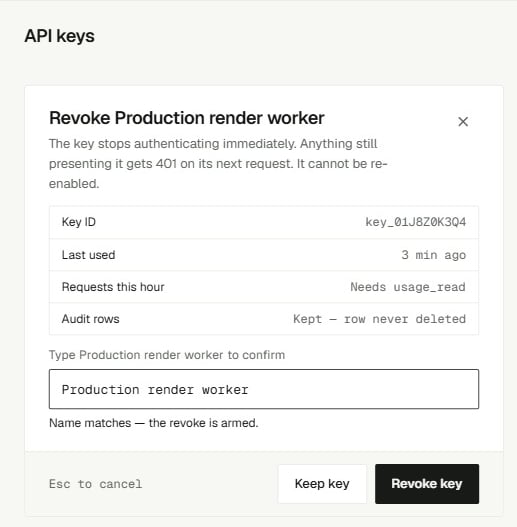
| **Revocation is immediate** | The next request with a revoked secret gets `401 invalid_credential`. |
| **Revocation is idempotent** | Revoking a revoked key returns `200` with the original `revoked_at`. A retry after a timeout is safe. |
| **Revoked keys stay listed** | `GET /v1/keys` includes them with `state: "revoked"`, as an audit trail. They are never deleted. |
| **A revoked key cannot come back** | You cannot re-enable or rotate it (`409 key_revoked`). Create a new key. |
| **Scopes cannot change** | There is no route to edit a key's scopes. Create a new key with the scopes you need, then revoke the old one. |
## Find unused keys
List every key in your organization and look at `state` and `last_used_at`. This needs `keys_read`. The list is newest first and never contains secrets.
```bash curl theme={"system"}
curl -sS https://api.opentype.dev/v1/keys \
-H "Authorization: Bearer $OPENTYPE_API_KEY" \
| jq -r '.keys[] | select(.state == "active") | [.id, .name, .secret_prefix, (.last_used_at // "never")] | @tsv'
```
```ts TypeScript theme={"system"}
const res = await fetch("https://api.opentype.dev/v1/keys", {
headers: { Authorization: `Bearer ${process.env.OPENTYPE_API_KEY}` },
});
const { keys } = await res.json();
const cutoff = Date.now() - 90 * 24 * 60 * 60 * 1000; // 90 days
for (const k of keys) {
if (k.state !== "active") continue;
const last = k.last_used_at ? Date.parse(k.last_used_at) : 0;
if (last < cutoff) console.log(`review ${k.id} ${k.name} ${k.secret_prefix} last used ${k.last_used_at ?? "never"}`);
}
```
```python Python theme={"system"}
import os
from datetime import datetime, timedelta, timezone
import requests
res = requests.get(
"https://api.opentype.dev/v1/keys",
headers={"Authorization": f"Bearer {os.environ['OPENTYPE_API_KEY']}"},
timeout=30,
)
res.raise_for_status()
cutoff = datetime.now(timezone.utc) - timedelta(days=90)
for k in res.json()["keys"]:
if k["state"] != "active":
continue
last = k["last_used_at"]
if last is None or datetime.strptime(last, "%Y-%m-%dT%H:%M:%SZ").replace(tzinfo=timezone.utc) < cutoff:
print(f"review {k['id']} {k['name']} {k['secret_prefix']} last used {last or 'never'}")
```
## Revoke a key
`DELETE /v1/keys/{key_id}` needs `keys_write`. Pass the `key_` id, never the secret.
```bash curl theme={"system"}
curl -sS -X DELETE https://api.opentype.dev/v1/keys/key_d12af855ae0f45b9925223d65562fd0e \
-H "Authorization: Bearer $OPENTYPE_API_KEY"
```
```ts TypeScript theme={"system"}
const keyId = "key_d12af855ae0f45b9925223d65562fd0e";
const res = await fetch(`https://api.opentype.dev/v1/keys/${keyId}`, {
method: "DELETE",
headers: { Authorization: `Bearer ${process.env.OPENTYPE_API_KEY}` },
});
const key = await res.json(); // key.state === "revoked"
```
```python Python theme={"system"}
import os
import requests
key_id = "key_d12af855ae0f45b9925223d65562fd0e"
res = requests.delete(
f"https://api.opentype.dev/v1/keys/{key_id}",
headers={"Authorization": f"Bearer {os.environ['OPENTYPE_API_KEY']}"},
timeout=30,
)
res.raise_for_status()
assert res.json()["state"] == "revoked"
```
```json theme={"system"}
{
"id": "key_d12af855ae0f45b9925223d65562fd0e",
"name": "ticket-router-prod",
"principal": {"type": "user", "id": "user_example"},
"scopes": ["runs_read", "runs_write"],
"state": "revoked",
"secret_prefix": "otsk_fde66231",
"created_by": "user_example",
"created_at": "2026-09-24T10:12:03Z",
"last_used_at": "2026-09-24T16:40:11Z",
"revoked_at": "2026-09-24T17:02:55Z"
}
```
You can also revoke from the console:
## Key object fields
| Field | Type | Notes |
| --------------- | ---------------- | ------------------------------------------------------------------------- |
| `id` | string | `key_` + 32 hex. Safe to log. |
| `name` | string | A label. Names do not have to be unique. |
| `principal` | object | `{"type": "user" \| "service_account", "id": "..."}`: who the key acts as |
| `scopes` | array of strings | Sorted, without duplicates. Fixed when the key is created. |
| `state` | string | `active` or `revoked` |
| `secret_prefix` | string | `otsk_` + 8 hex |
| `created_by` | string | The subject that created the key |
| `created_at` | string | UTC, `YYYY-MM-DDTHH:MM:SSZ` |
| `last_used_at` | string or null | `null` until the key is first used |
| `revoked_at` | string or null | Set when the key is revoked |
| `secret` | string | Create and rotate responses only |
There is no `expires_at`: keys do not expire.
## Lifecycle rules
| Rule | What it means for you |
| ---------------------------------- | ------------------------------------------------------------------------------------------------------------------------------------- |
| **Keys never expire** | A key works until you revoke it. Put revocation in your offboarding and decommissioning steps, and review old keys regularly. |
| **`last_used_at` is approximate** | It is updated in the background, at most once every 60 seconds per key. Use it to find unused keys, not to audit individual requests. |
| **Revocation is immediate** | The next request with a revoked secret gets `401 invalid_credential`. |
| **Revocation is idempotent** | Revoking a revoked key returns `200` with the original `revoked_at`. A retry after a timeout is safe. |
| **Revoked keys stay listed** | `GET /v1/keys` includes them with `state: "revoked"`, as an audit trail. They are never deleted. |
| **A revoked key cannot come back** | You cannot re-enable or rotate it (`409 key_revoked`). Create a new key. |
| **Scopes cannot change** | There is no route to edit a key's scopes. Create a new key with the scopes you need, then revoke the old one. |
## Find unused keys
List every key in your organization and look at `state` and `last_used_at`. This needs `keys_read`. The list is newest first and never contains secrets.
```bash curl theme={"system"}
curl -sS https://api.opentype.dev/v1/keys \
-H "Authorization: Bearer $OPENTYPE_API_KEY" \
| jq -r '.keys[] | select(.state == "active") | [.id, .name, .secret_prefix, (.last_used_at // "never")] | @tsv'
```
```ts TypeScript theme={"system"}
const res = await fetch("https://api.opentype.dev/v1/keys", {
headers: { Authorization: `Bearer ${process.env.OPENTYPE_API_KEY}` },
});
const { keys } = await res.json();
const cutoff = Date.now() - 90 * 24 * 60 * 60 * 1000; // 90 days
for (const k of keys) {
if (k.state !== "active") continue;
const last = k.last_used_at ? Date.parse(k.last_used_at) : 0;
if (last < cutoff) console.log(`review ${k.id} ${k.name} ${k.secret_prefix} last used ${k.last_used_at ?? "never"}`);
}
```
```python Python theme={"system"}
import os
from datetime import datetime, timedelta, timezone
import requests
res = requests.get(
"https://api.opentype.dev/v1/keys",
headers={"Authorization": f"Bearer {os.environ['OPENTYPE_API_KEY']}"},
timeout=30,
)
res.raise_for_status()
cutoff = datetime.now(timezone.utc) - timedelta(days=90)
for k in res.json()["keys"]:
if k["state"] != "active":
continue
last = k["last_used_at"]
if last is None or datetime.strptime(last, "%Y-%m-%dT%H:%M:%SZ").replace(tzinfo=timezone.utc) < cutoff:
print(f"review {k['id']} {k['name']} {k['secret_prefix']} last used {last or 'never'}")
```
## Revoke a key
`DELETE /v1/keys/{key_id}` needs `keys_write`. Pass the `key_` id, never the secret.
```bash curl theme={"system"}
curl -sS -X DELETE https://api.opentype.dev/v1/keys/key_d12af855ae0f45b9925223d65562fd0e \
-H "Authorization: Bearer $OPENTYPE_API_KEY"
```
```ts TypeScript theme={"system"}
const keyId = "key_d12af855ae0f45b9925223d65562fd0e";
const res = await fetch(`https://api.opentype.dev/v1/keys/${keyId}`, {
method: "DELETE",
headers: { Authorization: `Bearer ${process.env.OPENTYPE_API_KEY}` },
});
const key = await res.json(); // key.state === "revoked"
```
```python Python theme={"system"}
import os
import requests
key_id = "key_d12af855ae0f45b9925223d65562fd0e"
res = requests.delete(
f"https://api.opentype.dev/v1/keys/{key_id}",
headers={"Authorization": f"Bearer {os.environ['OPENTYPE_API_KEY']}"},
timeout=30,
)
res.raise_for_status()
assert res.json()["state"] == "revoked"
```
```json theme={"system"}
{
"id": "key_d12af855ae0f45b9925223d65562fd0e",
"name": "ticket-router-prod",
"principal": {"type": "user", "id": "user_example"},
"scopes": ["runs_read", "runs_write"],
"state": "revoked",
"secret_prefix": "otsk_fde66231",
"created_by": "user_example",
"created_at": "2026-09-24T10:12:03Z",
"last_used_at": "2026-09-24T16:40:11Z",
"revoked_at": "2026-09-24T17:02:55Z"
}
```
You can also revoke from the console:
 ## Rotate a key
`POST /v1/keys/{key_id}/rotate` issues a new secret for the same key. The `id`, `name` and `scopes` stay the same, and the response carries the new `secret` once. Rotation is available through the API only.
The old secret stops working the moment the rotation succeeds. There is no grace period. Every process still holding the old secret gets `401 invalid_credential` until it has the new one. For a zero-downtime change, create a second key, deploy it, then revoke the first. See [Key rotation](/guides/key-rotation).
```bash curl theme={"system"}
curl -sS -X POST https://api.opentype.dev/v1/keys/key_d12af855ae0f45b9925223d65562fd0e/rotate \
-H "Authorization: Bearer $OPENTYPE_API_KEY"
```
```ts TypeScript theme={"system"}
const keyId = "key_d12af855ae0f45b9925223d65562fd0e";
const res = await fetch(`https://api.opentype.dev/v1/keys/${keyId}/rotate`, {
method: "POST",
headers: { Authorization: `Bearer ${process.env.OPENTYPE_API_KEY}` },
});
if (res.status === 409) throw new Error("key is revoked; create a new key instead");
const key = await res.json();
// Store key.secret now. The previous secret is already dead.
```
```python Python theme={"system"}
import os
import requests
key_id = "key_d12af855ae0f45b9925223d65562fd0e"
res = requests.post(
f"https://api.opentype.dev/v1/keys/{key_id}/rotate",
headers={"Authorization": f"Bearer {os.environ['OPENTYPE_API_KEY']}"},
timeout=30,
)
if res.status_code == 409:
raise RuntimeError("key is revoked; create a new key instead")
res.raise_for_status()
new_secret = res.json()["secret"] # store it now; the previous secret is already dead
```
Do not rotate a key using that same key unless the calling process can switch to the new secret before its next request.
## If a secret leaks
A secret counts as leaked once it has been anywhere other than your secret store and the `Authorization` header of a request to `https://api.opentype.dev`: a commit, a chat message, a ticket, a log line, a screenshot, a URL, or client-side code.
Match the first 13 characters of the leaked value against `secret_prefix` in `GET /v1/keys` or in the console key list. Note its `id`.
If you can redeploy right away, rotate the key. The leaked secret stops working immediately and the key keeps its id and scopes. If you cannot redeploy right away, create a replacement key first, deploy it, then revoke the leaked one. Every minute in between, the leaked secret still works.
Update every process that held the old secret. Watch for `401 invalid_credential` in your logs, which shows a process you missed.
Review [usage](/guides/usage-reporting) and the run list for activity you do not recognize, and look at the key's `last_used_at`.
Delete the secret from wherever it leaked. Removing it from git history alone is not enough, because the secret stays valid until you complete step 2.
### A secret in a URL path
Key routes take the `key_` id in the path. If the path value starts with `otsk_`, the request is refused before any lookup:
```json theme={"system"}
{"error":{"code":"secret_in_path","message":"that value looks like a key secret, not a key id; rotate it and pass the key_ id","request_id":"req_7d3f0c1a9b2e4f6a8c0d1e2f3a4b5c6d"}}
```
Treat [`400 secret_in_path`](/problems/secret_in_path) as a leak. URLs end up in access logs, proxy logs and browser history, so rotate that key now, then fix the code to pass the `id` field.
## Key route errors
| Status | Code | When | Fix |
| ------ | ---------------------------------------------------------------------- | ----------------------------------------- | ------------------------------------------------------------ |
| 400 | [`empty_scopes`](/problems/empty_scopes) | `scopes` is `[]` on create | Request at least one scope |
| 400 | [`secret_in_path`](/problems/secret_in_path) | The path value starts with `otsk_` | Rotate that key, then pass the `key_` id |
| 400 | [`malformed_key_id`](/problems/malformed_key_id) | The path value does not start with `key_` | Use the `id` field of the key object |
| 403 | [`scope_exceeds_creator`](/problems/scope_exceeds_creator) | You asked for a scope you do not hold | Request only scopes you hold |
| 403 | [`principal_is_not_the_caller`](/problems/principal_is_not_the_caller) | `principal` names another user | Omit `principal`, or use a service account |
| 404 | [`key_not_found`](/problems/key_not_found) | No key with that id in your organization | Check the id; keys from another organization are not visible |
| 409 | [`key_revoked`](/problems/key_revoked) | You tried to rotate a revoked key | Create a new key |
## Storage checklist
* Keep secrets in a secret manager or encrypted environment variables, never in source control or container images.
* Never send a key to a browser or a mobile app. Call OpenType from your server.
* Log the key `id` or `secret_prefix`, never the secret. Scrub `Authorization` headers from your own request logs.
* Use one key per process and environment, named after what holds it, so you can revoke one without touching the others.
* Add a secret scanner rule for `otsk_[0-9a-f]{64}` to your repositories and CI.
## Related
* [Key rotation](/guides/key-rotation) - the overlap pattern and the rotate endpoint, step by step.
* [Console API keys](/console/api-keys) - create and revoke keys in the console.
* [Scopes and roles](/security/scopes-and-roles) - decide which scopes a new key should get.
* [secret\_in\_path](/problems/secret_in_path) - the full entry for a secret sent in a URL.
* [Authentication](/security/authentication) - how a key is checked on every request.
## Rotate a key
`POST /v1/keys/{key_id}/rotate` issues a new secret for the same key. The `id`, `name` and `scopes` stay the same, and the response carries the new `secret` once. Rotation is available through the API only.
The old secret stops working the moment the rotation succeeds. There is no grace period. Every process still holding the old secret gets `401 invalid_credential` until it has the new one. For a zero-downtime change, create a second key, deploy it, then revoke the first. See [Key rotation](/guides/key-rotation).
```bash curl theme={"system"}
curl -sS -X POST https://api.opentype.dev/v1/keys/key_d12af855ae0f45b9925223d65562fd0e/rotate \
-H "Authorization: Bearer $OPENTYPE_API_KEY"
```
```ts TypeScript theme={"system"}
const keyId = "key_d12af855ae0f45b9925223d65562fd0e";
const res = await fetch(`https://api.opentype.dev/v1/keys/${keyId}/rotate`, {
method: "POST",
headers: { Authorization: `Bearer ${process.env.OPENTYPE_API_KEY}` },
});
if (res.status === 409) throw new Error("key is revoked; create a new key instead");
const key = await res.json();
// Store key.secret now. The previous secret is already dead.
```
```python Python theme={"system"}
import os
import requests
key_id = "key_d12af855ae0f45b9925223d65562fd0e"
res = requests.post(
f"https://api.opentype.dev/v1/keys/{key_id}/rotate",
headers={"Authorization": f"Bearer {os.environ['OPENTYPE_API_KEY']}"},
timeout=30,
)
if res.status_code == 409:
raise RuntimeError("key is revoked; create a new key instead")
res.raise_for_status()
new_secret = res.json()["secret"] # store it now; the previous secret is already dead
```
Do not rotate a key using that same key unless the calling process can switch to the new secret before its next request.
## If a secret leaks
A secret counts as leaked once it has been anywhere other than your secret store and the `Authorization` header of a request to `https://api.opentype.dev`: a commit, a chat message, a ticket, a log line, a screenshot, a URL, or client-side code.
Match the first 13 characters of the leaked value against `secret_prefix` in `GET /v1/keys` or in the console key list. Note its `id`.
If you can redeploy right away, rotate the key. The leaked secret stops working immediately and the key keeps its id and scopes. If you cannot redeploy right away, create a replacement key first, deploy it, then revoke the leaked one. Every minute in between, the leaked secret still works.
Update every process that held the old secret. Watch for `401 invalid_credential` in your logs, which shows a process you missed.
Review [usage](/guides/usage-reporting) and the run list for activity you do not recognize, and look at the key's `last_used_at`.
Delete the secret from wherever it leaked. Removing it from git history alone is not enough, because the secret stays valid until you complete step 2.
### A secret in a URL path
Key routes take the `key_` id in the path. If the path value starts with `otsk_`, the request is refused before any lookup:
```json theme={"system"}
{"error":{"code":"secret_in_path","message":"that value looks like a key secret, not a key id; rotate it and pass the key_ id","request_id":"req_7d3f0c1a9b2e4f6a8c0d1e2f3a4b5c6d"}}
```
Treat [`400 secret_in_path`](/problems/secret_in_path) as a leak. URLs end up in access logs, proxy logs and browser history, so rotate that key now, then fix the code to pass the `id` field.
## Key route errors
| Status | Code | When | Fix |
| ------ | ---------------------------------------------------------------------- | ----------------------------------------- | ------------------------------------------------------------ |
| 400 | [`empty_scopes`](/problems/empty_scopes) | `scopes` is `[]` on create | Request at least one scope |
| 400 | [`secret_in_path`](/problems/secret_in_path) | The path value starts with `otsk_` | Rotate that key, then pass the `key_` id |
| 400 | [`malformed_key_id`](/problems/malformed_key_id) | The path value does not start with `key_` | Use the `id` field of the key object |
| 403 | [`scope_exceeds_creator`](/problems/scope_exceeds_creator) | You asked for a scope you do not hold | Request only scopes you hold |
| 403 | [`principal_is_not_the_caller`](/problems/principal_is_not_the_caller) | `principal` names another user | Omit `principal`, or use a service account |
| 404 | [`key_not_found`](/problems/key_not_found) | No key with that id in your organization | Check the id; keys from another organization are not visible |
| 409 | [`key_revoked`](/problems/key_revoked) | You tried to rotate a revoked key | Create a new key |
## Storage checklist
* Keep secrets in a secret manager or encrypted environment variables, never in source control or container images.
* Never send a key to a browser or a mobile app. Call OpenType from your server.
* Log the key `id` or `secret_prefix`, never the secret. Scrub `Authorization` headers from your own request logs.
* Use one key per process and environment, named after what holds it, so you can revoke one without touching the others.
* Add a secret scanner rule for `otsk_[0-9a-f]{64}` to your repositories and CI.
## Related
* [Key rotation](/guides/key-rotation) - the overlap pattern and the rotate endpoint, step by step.
* [Console API keys](/console/api-keys) - create and revoke keys in the console.
* [Scopes and roles](/security/scopes-and-roles) - decide which scopes a new key should get.
* [secret\_in\_path](/problems/secret_in_path) - the full entry for a secret sent in a URL.
* [Authentication](/security/authentication) - how a key is checked on every request.